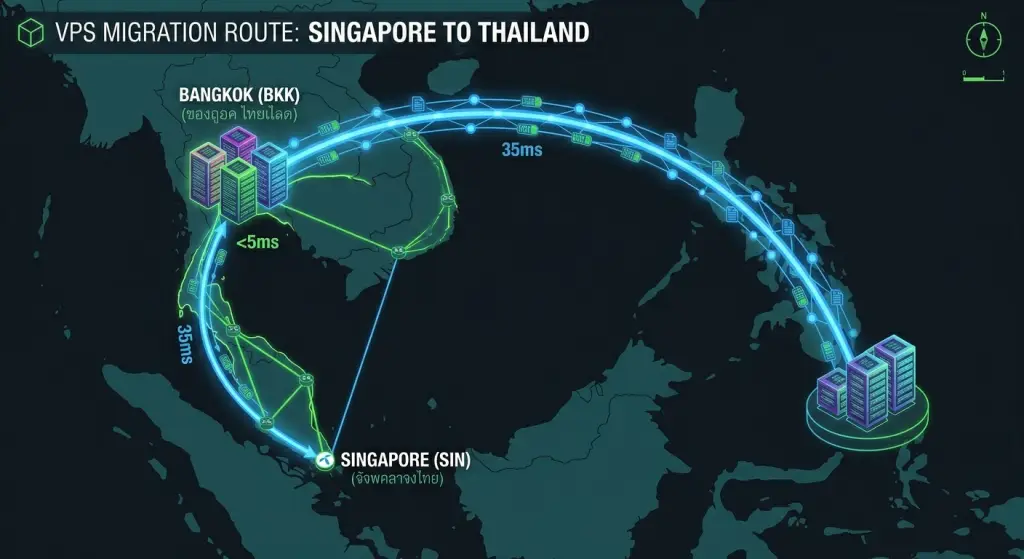
The direct answer: To migrate infrastructure from Singapore to Thailand without downtime, you must implement a three-stage transition: first, lower your DNS TTL (Time to Live) to 300 seconds; second, set up asynchronous database replication (Master-Slave) between the Singapore source and the Bangkok destination; and third, use rsync for final file synchronization before performing a DNS cutover. Migrating to a Bangkok-based VPS on serverly.host reduces latency for Thai users from ~40ms to <10ms.
Why Migrate from Singapore to a Bangkok-Based VPS?
Migrating your server infrastructure from Singapore to Bangkok is primarily driven by the need for lower latency, local data storage, and optimized routing for the AEC (ASEAN Economic Community) market. While Singapore is a major regional hub, Thai users experience a physical latency overhead of 30ms to 60ms when accessing Singaporean data centers due to international gateway congestion.
By moving to a server in Bangkok, businesses achieve sub-10ms round-trip times (RTT) within Thailand.
The Zero-Downtime Migration Blueprint: Technical Execution
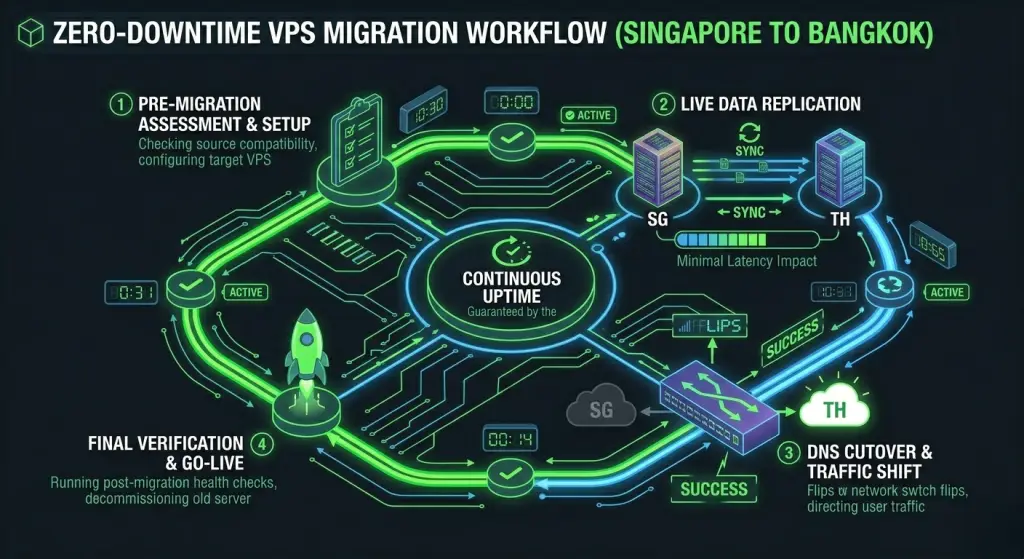
A seamless migration relies on maintaining data consistency between the legacy Singapore server and the new Thailand VPS during the propagation period. To execute this without a “maintenance mode” window, follow this technical framework:
- DNS Preparation: 48 hours before migration, reduce your DNS TTL to 5 minutes (300 seconds). This ensures that when you point your domain to the new Bangkok IP, the change reflects globally almost instantly.
- Database Synchronization: Instead of a static export/import, configure the Bangkok server as a “Slave” to the Singapore “Master.” Use tools like MySQL/MariaDB replication to keep the Thai database updated in real-time.
- Continuous File Sync: Utilize rsync with the -avz flag to transfer large media libraries and application files. Run a final “delta sync” immediately before the cutover to catch any files uploaded in the last seconds.
- The Cutover: Change the DNS A-record to the serverly.host Bangkok IP. Once traffic stabilizes on the new server, promote the Thai database to “Master” and decommission the Singapore instance.
Overcoming Regional Latency: How Bangkok Powers the AEC
Bangkok serves as the “Land-Bridge” hub for the AEC, offering superior terrestrial connectivity to Cambodia, Laos, Myanmar, and Vietnam (CLMV) compared to Singapore. While Singapore relies heavily on subsea cables, Bangkok’s geography allows for direct fiber-optic cross-border links.
A VPS in Thailand hosted via serverly.host leverages the Thailand National Internet Exchange (THIX) and local BGP peering with major ISPs like AIS, True, and DTAC. This results in a “local-feel” user experience across the entire Mekong sub-region, making it the strategic choice for platforms targeting the $300 billion Southeast Asian digital economy.
Technical Checklist for a Seamless Transition to Serverly.host
A successful move to a Thai VPS requires auditing your environment for hardcoded IPs and localized configurations. Use this checklist to ensure your serverly.host instance is optimized from day one:
- Update Configuration Files: Search for hardcoded Singaporean IP addresses in your .env or wp-config.php files.
- Verify PHP-FPM & Nginx Settings: Ensure your Bangkok server environment matches your source server’s versioning (e.g., PHP 8.3) to prevent code regressions.
- SSL/TLS Migration: Export your existing Let’s Encrypt or Wildcard SSL certificates to the new Thai server to prevent “Connection Not Private” errors during cutover.
- Test Local Routing: Use traceroute to confirm your traffic is staying within the Thailand Internet Exchange and not “tromboning” back through Singapore.
Ready to bring your data home? Start your Zero-Downtime Migration to Bangkok and cut your latency in half today.