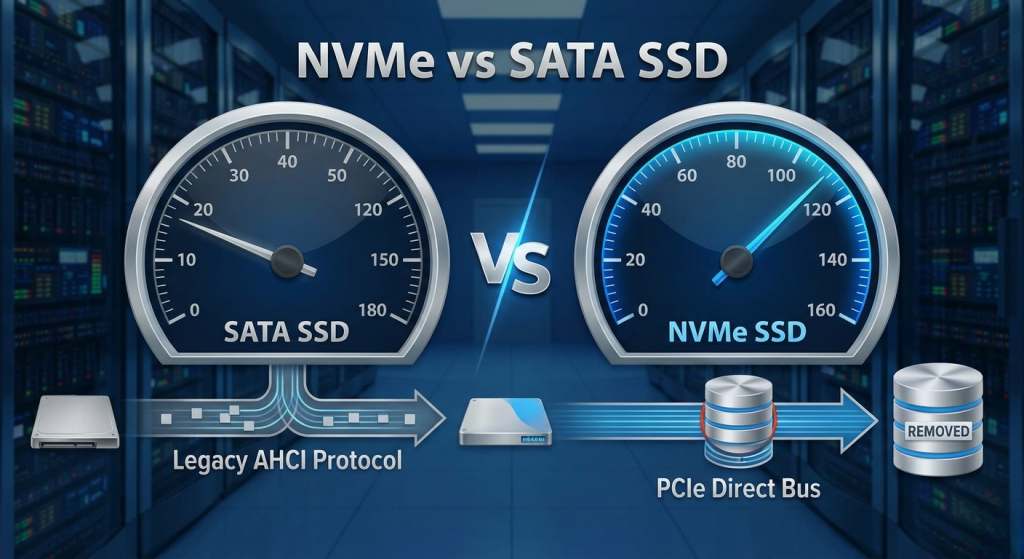
The direct answer: NVMe (Non-Volatile Memory Express) SSDs are up to 7x faster than traditional SATA SSDs because they connect directly to the motherboard’s PCIe bus, bypassing the legacy bottlenecks that slow down data-heavy applications. For e-commerce sites in Thailand, switching to an NVMe VPS in Bangkok eliminates the “database bottleneck,” reducing checkout lag and improving search query speeds for local and AEC-based customers.
The Performance Gap: NVMe vs. SATA SSDs
NVMe drives offer superior throughput and lower latency compared to SATA SSDs by utilizing the PCIe interface instead of the aging SATA III protocol. While a high-end SATA SSD caps out at roughly 550 MB/s, modern NVMe drives regularly exceed 3,500 MB/s.
For e-commerce platforms like Magento, WooCommerce, or PrestaShop, this speed difference isn’t just a technical spec—it’s the difference between a snappy user interface and a frustrated customer. SATA drives use the AHCI protocol, designed for spinning hard disks, which creates a “traffic jam” when your site tries to process multiple customer orders simultaneously. NVMe was built specifically for flash memory, allowing for massive parallel processing.
Feature | SATA SSD | NVMe SSD | Impact on E-commerce |
Max Speed | ~550 MB/s | ~3,500+ MB/s | Faster page loads |
Interface | SATA III (Legacy) | PCIe (Direct) | Lower system latency |
IOPS | Up to 100,000 | Up to 1,000,000+ | Handles more concurrent users |
Queue Depth | 32 commands | 65,535 commands | No lag during peak sales |
Why Database Latency Kills Conversions in Thailand
Slow database queries are the primary cause of high bounce rates on Thai e-commerce sites. Every time a user filters a product, adds an item to a cart, or searches for a brand, your server must perform a “Read/Write” operation on the database.
On a standard SATA-based VPS, these operations get queued. If you are running a flash sale or a marketing campaign in the AEC region, a SATA drive’s limited IOPS (Input/Output Operations Per Second) becomes a bottleneck. By hosting on an NVMe-powered VPS in Bangkok, your database can fetch product data almost instantaneously, ensuring that users in Bangkok, Ho Chi Minh, or Singapore experience zero friction during the “Golden Hour” of shopping.
The Strategic Advantage of Bangkok-Based Hosting for the AEC

Choosing a VPS with servers located in Bangkok provides the lowest possible physical latency for the AEC market. While “The Cloud” feels invisible, data still travels through physical cables. If your server is in the US or Europe, your Thai customers face a 200ms+ delay before the page even begins to load.
Combine the raw power of NVMe hardware with geographical proximity. This “Double-Threat” of speed means:
- Lower Latency: Sub-10ms ping for users within Thailand.
- AEC Connectivity: Optimized routing to neighboring hubs like Cambodia, Laos, and Myanmar.
- SEO Benefits: Google prioritizes local server IP addresses for localized search results in the Thai language.
Scaling with NVMe: Future-Proofing
NVMe storage is the foundation of a scalable AEC business because it handles “Burst Traffic” without hardware degradation. Traditional drives can “choke” when traffic spikes, leading to 504 Gateway Timeout errors. NVMe’s ability to handle over 64,000 command queues ensures that your site remains stable during high-traffic events like 11.11 or 12.12 sales.
When you deploy an instance with serverly.host, you aren’t just getting disk space; you are getting high-throughput SSD architecture specifically optimized for:
- High-Frequency Trading & FinTech: Where every millisecond equals revenue.
- Dynamic E-commerce: Where databases are constantly being queried and updated.
- Heavy CMS Workloads: Speeding up the backend admin experience for your team.