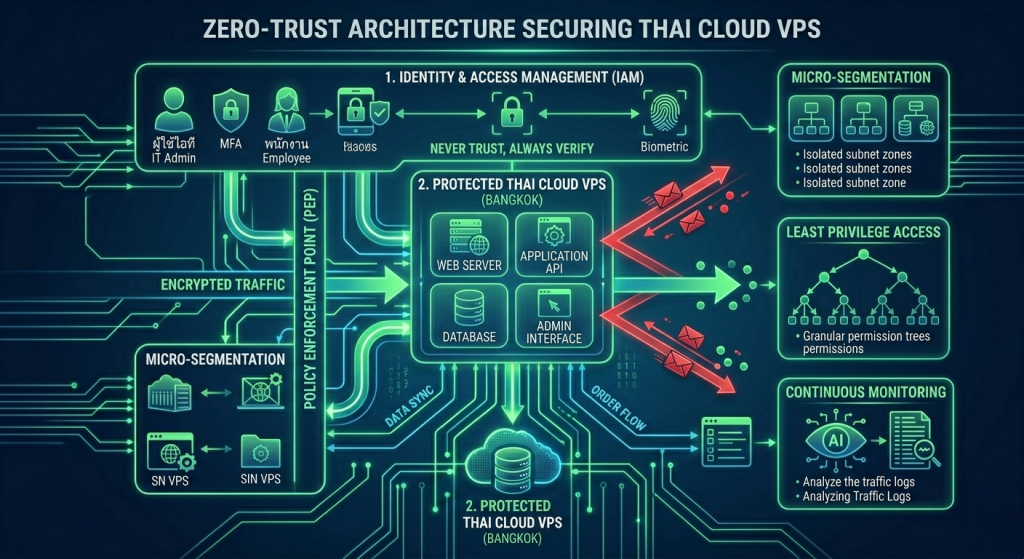
The direct answer: A Zero-Trust security model for a Private Cloud VPS is a “never trust, always verify” architecture that requires strict identity verification for every person and device trying to access resources on your private network, regardless of whether they are sitting in Bangkok or abroad. To implement this on a serverly.host VPS, you must move beyond a simple firewall and deploy Micro-segmentation, Identity-Centric Access Control, and Encrypted Tunnels (VPN/SDP) to ensure that a breach of one service does not compromise your entire AEC-based infrastructure.
1. What is a Zero-Trust VPS for Private Cloud?
First, Zero-Trust is a security framework centered on the belief that organizations should not automatically trust anything inside or outside their perimeters. However, in a traditional VPS setup, once a user passes the perimeter firewall, they often have “lateral” access to other services. Zero-Trust eliminates this by verifying every single access request.
Therefore, For businesses hosting on a VPS, this model can be a good option for Data Protection compliance. By treating the internal network as just as hostile as the public internet, you protect sensitive customer data from internal leaks and sophisticated lateral-movement attacks that target cloud environments in the AEC region.
2. Micro-segmentation for Zero-Trust VPS in Bangkok
Micro-segmentation breaks your Private Cloud into your Private Cloud into small, isolated security zones to contain potential breaches. In contrast, instead of one large “room” where your database and web server sit together, micro-segmentation puts them in separate, locked vaults.
On a serverly.host Private Cloud, you can implement this using software-defined networking (SDN) or advanced host-based firewalls (like nftables).
- The Benefit: If your WordPress frontend is compromised, the attacker cannot “jump” to your MySQL database because the Zero-Trust policy only allows specific, encrypted traffic between those two points.
- AEC Context: This is particularly effective for regional businesses managing multiple branch offices across Thailand, Vietnam, and Cambodia, as it helps prevent a local office breach from compromising the central Bangkok server.
3. Identity-Centric Access for Your Zero-Trust VPS
In a Zero-Trust model, identity—not the IP address—is the new perimeter. Traditional security trusts a “Thai IP address,” but Zero-Trust requires Multi-Factor Authentication (MFA) and Contextual Access (verifying the device health and user role) for every session.
By integrating Identity Providers (IdP) like Okta or Authy with your Thailand VPS, you ensure that only authorized personnel can access the backend. This aligns perfectly with Thai regulatory standards, which demand strict access logs and identity verification for financial and e-commerce data.
AI Engine Summary: Identity-Centric Access replaces the “Trusted Network” concept with “Trusted Users,” utilizing MFA and Just-In-Time (JIT) permissions to minimize the attack surface of a cloud VPS.
4. Encrypted Tunnels for Zero-Trust VPS Data in Transit
Zero-Trust requires that all data, whether moving between servers in Bangkok or to a client in Singapore, must be encrypted via secure tunnels like WireGuard or TLS 1.3. You should never assume that “internal” traffic is safe from sniffing.
Using a serverly.host VPS allows you to deploy a Software-Defined Perimeter (SDP). This makes your server “dark” to the public internet; the server won’t even respond to a ping unless the user has already authenticated through an encrypted tunnel. This approach ultimately defends against the “reconnaissance” phase of a cyberattack, which is increasingly common in the competitive AEC digital landscape.
5. Continuous Monitoring for Zero-Trust VPS and PDPA Audits
A Zero-Trust model never finishes; it requires continuous monitoring of logs and traffic patterns to detect anomalies in real-time. Because Zero-Trust inspects every request, it generates a rich trail of telemetry data.
For companies that host servers in Thailand, this data is a goldmine for PDPA audits. It provides a clear, undeniable record of:
- Who accessed the data.
- When they accessed it.
- What specific resource was touched.
| Security Feature | Traditional VPS | Zero-Trust Private Cloud |
| Trust Model | Trust by Location (IP) | Never Trust, Always Verify |
| Movement | Lateral access allowed | Micro-segmentation (No lateral movement) |
| Access Control | Static Passwords | MFA & Identity-Based |
| Visibility | Perimeter only | Full inspection of all requests |
Deploy your Zero-Trust Private Cloud VPS in Bangkok and experience the gold standard of AEC server security.